
Investor Center
An architecture that compounds into a moat.
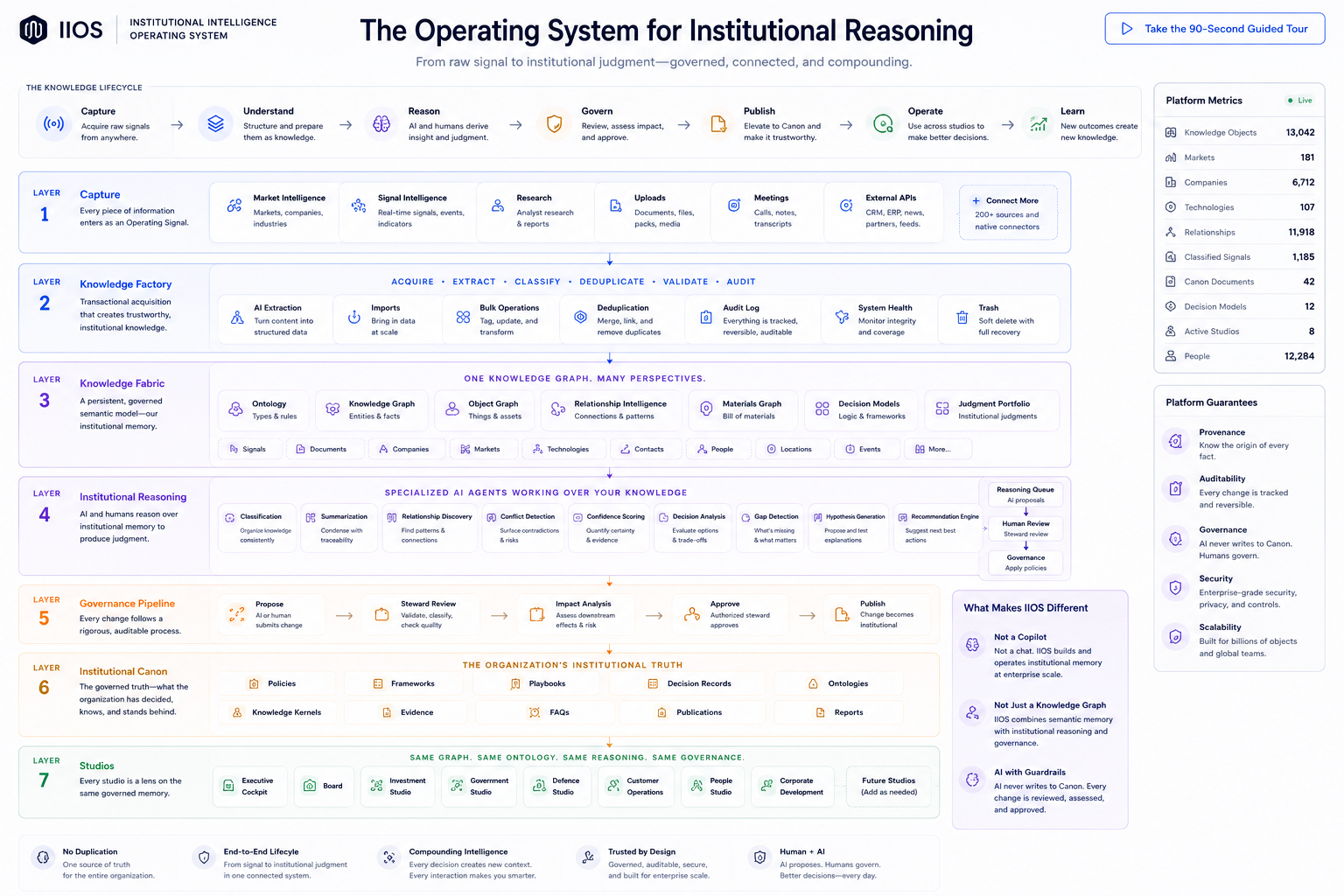
IIOS does not just help organizations decide. It captures every decision as governed institutional memory — an asset that accumulates, embeds, and becomes harder to replicate with every passing year.
The investment thesis
Durable advantage, by design.
Point tools get commoditized. Systems of record do not. IIOS is built to become the system of record for judgment — the layer an enterprise cannot easily leave once it has moved in.
- 1
Why this architecture compounds
Every decision made in IIOS is captured as governed institutional memory. Because knowledge accumulates rather than resets, each additional customer-year makes the system more valuable and more deeply embedded — a widening gap that is expensive to reverse.
- 2
Why ontology matters
The ontology is the shared language of the enterprise. Once an organization models its world in IIOS, that model becomes the substrate for every team and workflow. Switching would mean re-teaching a competitor everything the organization means — a structural source of lock-in.
- 3
Why governance matters
Governance is what lets an enterprise trust the system enough to run on it. That trust is earned over time and is very hard for a point tool to retrofit. It turns IIOS from a useful application into the system of record for judgment.
- 4
Why the Canon becomes a moat
The Institutional Canon is the accumulated, governed judgment of the enterprise — versioned, traceable, and owned by the customer. It cannot be copied, scraped, or reconstructed by a competitor. The longer IIOS runs, the deeper and more defensible the moat.
The longer IIOS runs inside an organization, the more valuable it becomes — and the harder it is for anyone to replace.
Institutional memory is the rare software asset that appreciates with use. Every governed decision widens the gap between a customer running on IIOS and one still deciding without a memory.