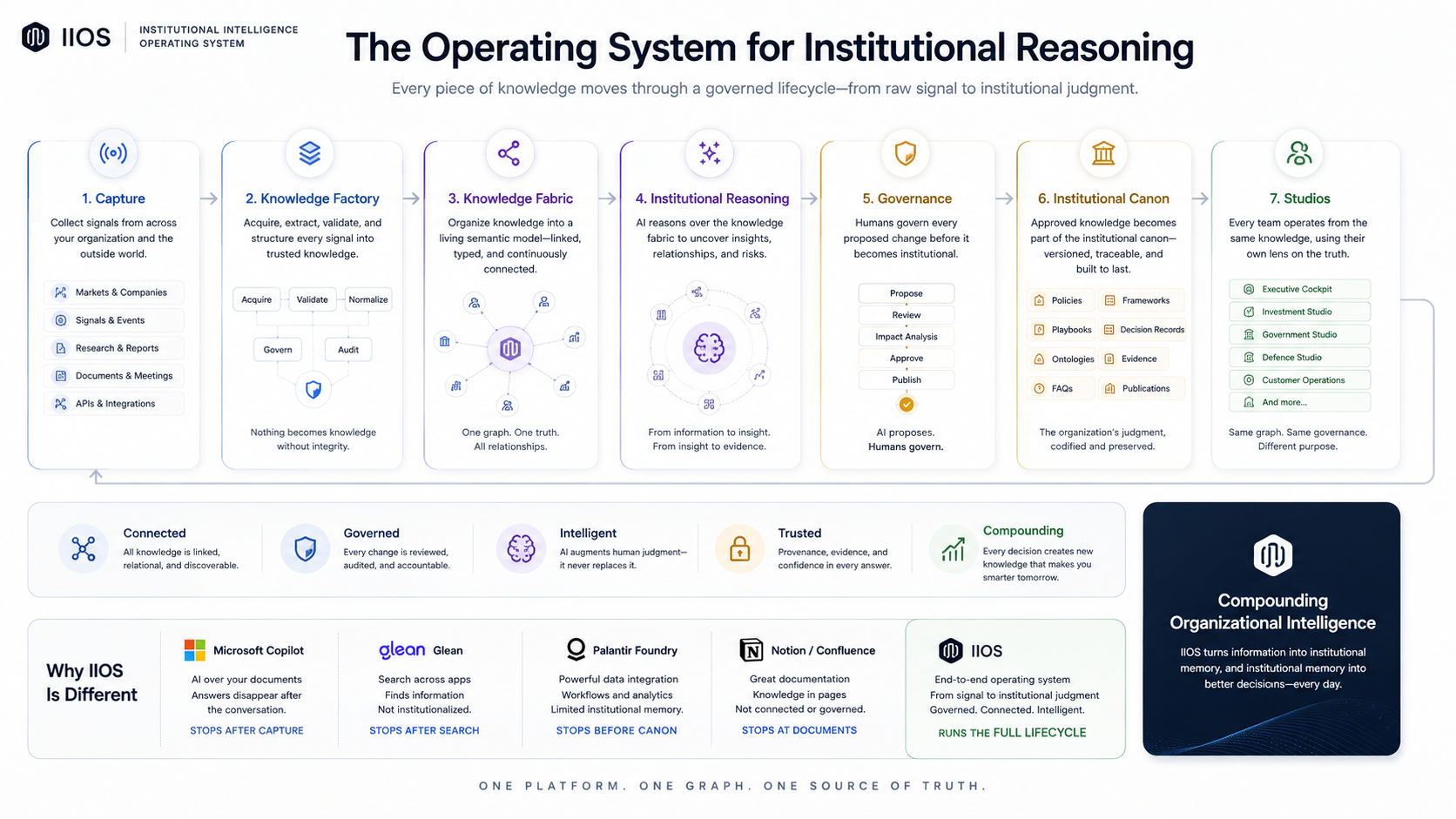
Every view is the same governed lifecycle. Here is what each layer does and why it matters.
01
Capture
Every piece of information enters as a governed Operating Signal.
Information reaches an organization from markets, research, documents, meetings, and the systems it already runs. A Cognitive Enterprise treats all of it as something the institution observed — not as files scattered across inboxes, slides, and private drives.
What is observed but never retained cannot inform judgment. Capture is simply the commitment that nothing the organization learns is stranded.
02
Knowledge Factory
Transactional acquisition that turns raw signal into trustworthy knowledge.
Raw information is not yet knowledge. Before an organization can rely on something, it must be able to say where it came from, whether it holds up, and what has happened to it since.
Integrity is the precondition for institutional knowledge. Every change should be traceable and reversible, so the institution can always answer “where did this come from?”
03
Knowledge Fabric
A persistent, governed semantic model — institutional memory.
Institutional memory is not a pile of documents. It is a connected understanding of what the organization knows — the entities, relationships, and decisions that matter — held as one shared picture rather than many copies that drift apart.
When memory is shared, every part of the organization reasons from the same understanding of the world.
04
Institutional Reasoning
AI and humans reason over memory to produce judgment.
People and AI reason over institutional memory to reach judgment. AI can widen what an organization notices and accelerate its analysis; people remain accountable for what the organization concludes.
Good organizational reasoning grounds new information in what is already known, surfaces disagreement rather than burying it, and makes trade-offs explicit.
05
Governance Pipeline
Every change follows a rigorous, auditable process.
Before anything becomes institutional, someone accountable decides that the organization stands behind it. Review should be proportionate to consequence.
Governance is what separates a store of information from an institution’s considered position. It is how the organization decides what it is prepared to be held to.
06
Institutional Canon
The governed truth — what the organization has decided and knows.
The Canon is what the organization has decided and knows — its policies, frameworks, decision records, and evidence — versioned, traceable, and built to outlast any individual.
Because it is governed rather than generated, it can be trusted, and because it is kept, it compounds.
07
Studios
Every studio is a lens on the same governed memory.
Different roles need different views — executives, boards, investment teams, operators, public institutions. Each should work from the same governed understanding rather than its own copy.
A change made once is then reflected everywhere it is relevant, because there is one understanding beneath every view.